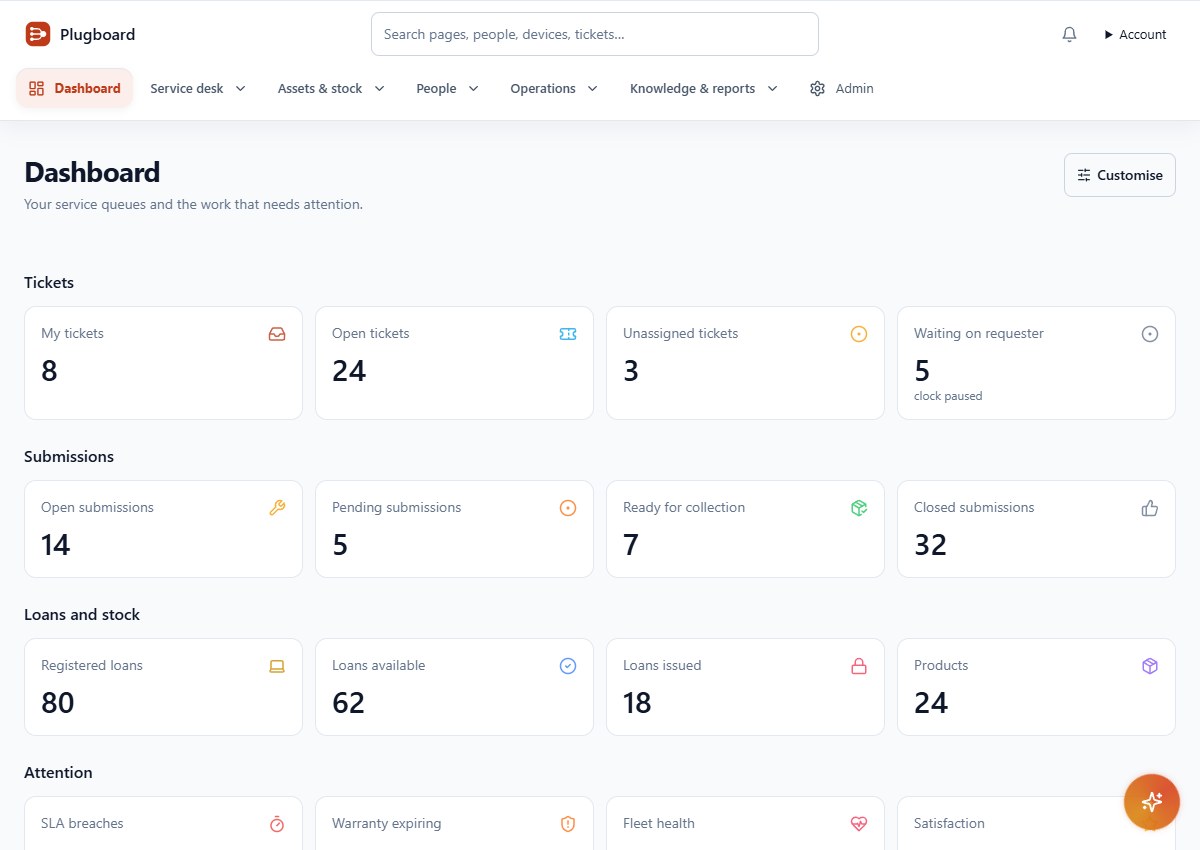
From the first support request to the next campus-wide project. Connect your people, assets, facilities and systems in one workspace built for education.
Across your campus IT, facilities and administrationBuilt around your systems Identity, devices, finance and moreHosted or self-hosted Choose where your data lives
Good work shouldn’t get lost between teams.
A request is only the start. Plugboard connects the people, equipment and follow-through behind it.
One place to ask for help.
Give staff, students and families a clear way in. Route requests to the right service desk, with the person, location and device already in view.
Bring a facilities request into a project. Reserve a resource, track a repair or prepare a purchase. Each team sees the work it needs, with access you control.
Auto-numbered loans with MDM serial autocomplete, bulk pull from a device group, holder history and policy links.
Repairs & submissions
The full repair lifecycle: configurable coverage, repair types, vendor sync, ready-for-collection, costs and outcomes.
Built-in and external ticketing
Use the ticket system that comes with the desk, or connect Zendesk, Salesforce and more. Statuses and types map across and stay in sync.
Triage the moment it arrives
A request is filed against the service it concerns, then sorted, prioritised and routed as it lands, the way ITIL asks for.
SLAs & escalation
Response and resolution targets per priority, with automatic escalation and alerts when a ticket is heading for a breach.
Automation rules
When-this-then-that rules handle the routine: auto-assign, notify, change status, escalate or fire a webhook, with no scripting.
Ticket actions you define yourself
Put the actions your desk actually takes on the ticket itself, pressed by hand or fired by a rule, and bounded so a button can never reach past the permissions of whoever presses it. A ticket that names a service links to its monitor, and the article that resolved it is recorded on it.
Analytics & reporting
Break costs down by repair type, coverage, month or your own terms, schedule reports to email out, and export to CSV.
Stock, purchases & assets
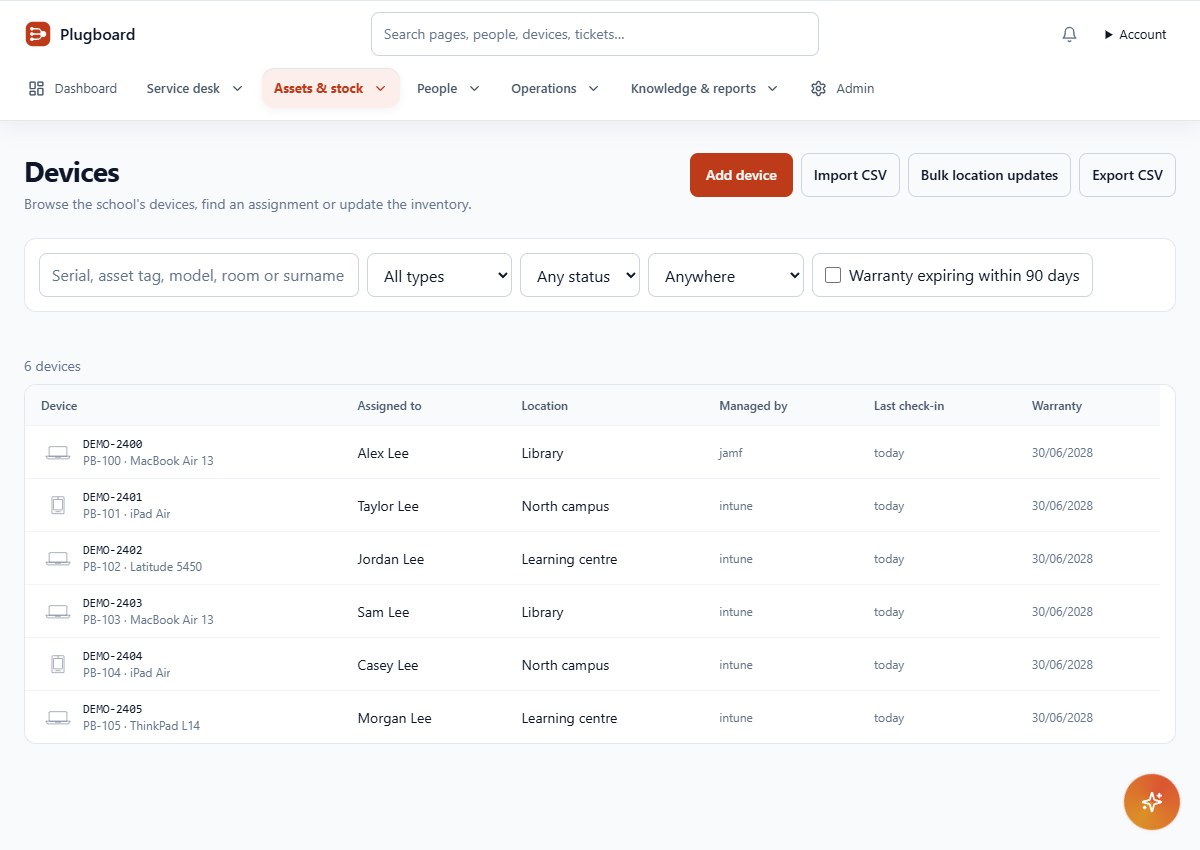
Track consumables and assets from purchase to retirement, with stocktake, charges, budget codes and per-client purchase records.
Bulk device handout
Hand out and collect school-issued devices each year, with reusable programs, custom fields, photo check-in and on-the-spot swaps.
Every device, as each system sees it
One record per device, assembled from everything that reports it: the MDM, the warranty vendor, Apple School Manager and the asset tag on the lid. Where two systems disagree the page shows both rather than quietly picking one, and a field nobody reports says so instead of reading as zero.
Retirement & proof of wipe
Retire a device with the evidence attached: who wiped it, when, by what method, and where it went. The certificate lives with the asset.
Wipes and admin passwords, behind two locks
A remote wipe and a local administrator password are off until two different permissions switch them on. Both require fresh verification, typed serial confirmation and a written reason. Wipes also use a cooling-off period and, by default, a second approver, and the audit row is written before the command leaves rather than when it comes back.
Family billing with consent
Charge a family for a cracked screen and keep the record of who approved it, when and for how much. Parents see it in their own portal.
Knowledge base & CSAT
A self-service knowledge base for the common fixes, plus satisfaction surveys that tell you how each job landed.
Directory & user management
Read live Entra and Google identity information beside the person record. SCIM provisions technician accounts; LDAP sign-in is separate from the legacy directory demonstration workflow.
Identity, beside the rest of the person
Account state, registered MFA methods, Conditional Access and recent sign-ins, read live from Entra and shown next to the same person’s tickets, loans and devices. A sign-in from Jakarta reads differently there. None of it is stored, and the licences sitting on disabled accounts are counted on the same page.
Guarded identity actions
Entra supports MFA reset, account state changes, session revocation, licence changes and password reset. Google supports account state changes and session revocation. Each one needs its own permission, a second factor there and then, and the person’s name typed by hand and checked against what the provider reports now.
Printer fleet monitoring
Watch the print fleet from the same console, with toner levels, status and alerts pulled live.
The network, on one board
Meraki, UniFi and SNMP switching merged into a single view instead of one vendor at a time: access points, switches, gateways and uplink loss, grouped by campus. A device that drops raises an alert on the monitor board you already run, and a ticket saying the senior school wifi is down finds the device it means.
Service monitoring
Watch the services your desk depends on from a live status board, with HTTP, TCP, TLS and ping checks, certificate expiry and a public status page.
An assistant, with a model in the box
Ask it to find a student, look up a serial or lodge a repair, and it uses the same permissioned tools your technicians do. Container deployments can include a local model sidecar. Native/source installs need a separately configured model; without one the built-in command engine remains available. External AI connectors send context to their configured provider.
You decide where the AI runs
Run an Ollama model on your infrastructure or use Anthropic or an OpenAI-compatible endpoint on your own key. Managed plans with hosted AI use DigitalOcean Gradient AI; review the selected connector and provider terms.
Connector agents
Let us host Plugboard and still reach systems that never touch the internet. A small agent runs on your network and dials out, so there is no inbound rule and no open port to ask for. Credentials stay on your machine.
Open API, webhooks & MCP
A documented REST API with scoped keys, outbound webhooks, and a built-in MCP server, so the systems and AI tools you use can work with the desk directly.
Live dashboard & audit
A live view of the day: stats, activity and who is doing what, with audit records for covered operations and configurable retention.
Arranged the way each person works
Choose modern or classic, light or dark, and navigation along the top or either side. Keep school defaults or save your own arrangement and dashboard.
People, devices and support requests, connected in the same workflow.
Facilities & spaces
Location-aware service forms and recurring maintenance for the places you look after.
Administration & beyond
Dedicated desks, controlled membership and ticket transfers when another team needs to take over.
The next term starts with a plan.
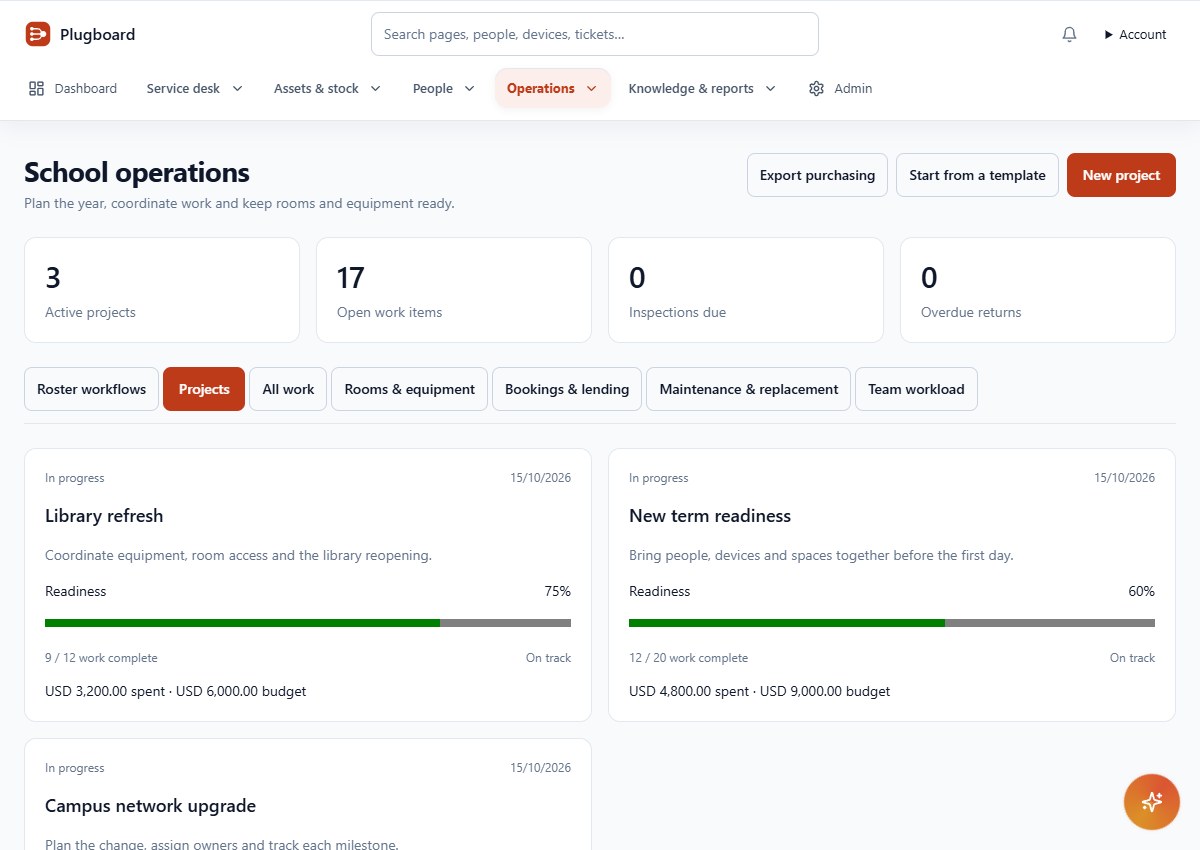
Connect the longer view to the everyday work. Projects, people and shared resources, alongside your service desk.
Actual product UI · Fictional demo data
Give the big picture a next step.
Link school-year projects to work items, resource bookings and shared approvals. Review purchasing through supported Xero or MYOB workflows.
Be ready for arrivals. And departures.
Plan starter and leaver work from synced rosters. Capture stocktake serials offline, then review conflicts when you reconnect.
See what needs attention.
Monitor Q-SYS Cores, PJLink projectors and displays, Crestron XiO Cloud equipment and Zoom Rooms from the same campus view. Read supported status and faults alongside service alerts and ticket signals. Explore AV monitoring; validate your hardware and vendor account in a pilot before rollout.
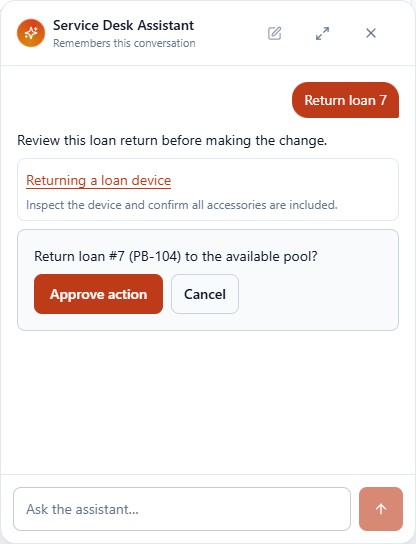
A helping hand. With you in control.
Let the native assistant prepare supported actions for your review and approval.
Module availability & setup
These optional modules require explicit activation and entitlement. Confirm your plan includes them before enabling them.
Click around the real thing
A running copy of Plugboard, loaded with fictional students, devices and repairs. Lodge a job, issue a loan, run the assistant. Nothing to install and no sign-up.
Fictional data · No sign-up · Explore at your own pace
Some actions are disabled in the public sandbox (backups, connector credentials, API keys). Book a walkthrough to see those on your own data.
Plug in the tools you already run
Keep the systems your school relies on. Plugboard connects your SIS, device management and identity tools, bringing the information your service desk needs into one workspace.
Managing a district? Plugboard 0.14.0 adds named connections for separate Jamf, Entra and Google Workspace instances, with shared or selected-campus coverage. Check your deployment version and read the district setup guide for supported workflows and rollout requirements.
The 0.14.1 interface update aligns buttons and form controls across the desk, including loan actions and readable tables on phones. Version 0.14.2 puts core identity, device and student systems first in Admin connector setup. Read the patch notes and check availability in your deployment.
AV adapters and TeamViewer status need a hardware or account pilot before production rollout. Extron and Teams Rooms integrations are planned. Calendar and chat workflows extend the Entra or Google directory connection; sign-in providers are configured separately. Finance exports require provider authorization, agreed mappings and approval. Review setup and supported operations.
One custom connector, built for you, included in the beta
Running an MDM, SIS or ticketing tool we have not listed yet, or one specific to your country? Beta institutions get one custom connector, scoped with you up front and delivered inside the trial. Standard onboarding and a standard data import are included on every plan. Complex migrations are quoted before work starts.
Run a configured local model on your own infrastructure, or choose an external AI provider. You control the connection and where its data goes.
Review security and data controls
The assistant runs on your own model
A local model sidecar is available for container deployments, keeping inference on your infrastructure. Native/source installs need a separately configured model. Local inference needs no external AI provider. You can choose Anthropic or an OpenAI-compatible endpoint on your own key; managed plans that include hosted AI use DigitalOcean Gradient AI. The configured provider and data flows belong in your privacy assessment.
Your credentials stay yours
Connector secrets are encrypted in the vault and decrypted for the integration that needs them. The application redacts secret fields in normal responses and logs. Sensitive credential-retrieval actions have separate permissions, step-up and auditing.
One school cannot see another
Every record belongs to a single school, and nothing reaches across that line. On our hosting you get a server of your own — your own database, disk and backups, with no other school’s deployment on the machine.
Roles you write yourself, held on one campus
Start from the built-in roles or write your own, and give somebody a role on a single site rather than across the group. Staff sign in with Entra, Google, custom OIDC or SAML providers, and you can require two-factor across the whole team.
Passkeys on the technician console
Staff can sign in with a passkey, or use one as the second factor on a sensitive action. You decide whether passkeys are off, offered or required, and whether the one built into a shared staffroom laptop counts. Students tapping cards and parents following links are untouched.
Verify sensitive actions
Wiping a device, reading a local administrator password or resetting somebody’s MFA requires recent additional verification using a supported account factor. The audit row goes in before the command is sent, so an action that times out on the way home still left a trace.
Audit records with clear limits
The audit log records covered operations; authentication and some configuration changes have gaps. The normal interface does not offer audit editing. Retention and authorised erasure remove records according to policy; database operators retain administrative control. You can export audit records and manage retention.
Protected against abuse
Managed ingress uses HTTPS and edge protections. Public endpoints also apply request validation and rate limits; self-hosted operators configure their TLS and network controls.
Data residency you control
Choose your hosting region and we put the residency statement in writing. Your application database lives in that region. Connector, email, external AI and edge processing have separate locations. Or run the application on your own infrastructure and choose its external connections. We can cover most regions to meet your school’s hosting needs.
Encrypted backups, and an export that is yours
Backups can run on a schedule and are encrypted. Export your own school whenever you want, and verify restores as part of your deployment runbook.
Sign-in that survives an outage
A configured local emergency account can provide access during an identity-provider outage, where your sign-in policy allows local authentication.
Choose your hosting region, or keep everything on your own hardware. Your data exports in full, so you can move between the two later.
Hosted SaaS Managed
Your own subdomain or a custom domain
A server of your own, with no other school on it
Fully managed: provisioning, certificates and the pager
Backups, monitoring and upgrades handled for you
Per-institution branding
Each school in its own colours, logo and enabled modules.
Choose your hosting region
We can cover most regions. Choose a hosting location that works for your school.
Still reaches your on-prem systems
A connector agent bridges to AD, a local SIS or printers, with no open ports.
Self-hosted Your infra
Native installers are not currently published. Linux x64 is the planned bundle target. Check available downloads and checksums for current distribution options.
Host the Plugboard application and database on your infrastructure
Built-in TLS/HTTPS, no extra reverse proxy
Self-contained runtime
When available, the native bundle includes its runtime and database.
Runs as a service, patches itself
Installs properly, serves HTTPS, backs up before each update.
No lock-in
Move to managed hosting later, or stay where you are. The export is the same either way.
Plugboard connects to your student information system and device management tools. They remain the source systems; your team uses Plugboard to bring their information into service-desk workflows.
Can Facilities and the school office use Plugboard?
Optional department desks are included in Plugboard 0.12.0. They share ticket history, service forms and recurring work while applying department membership and existing role permissions. They are not a dedicated HR, finance or building-management system. Check the guide and prerequisites. We will confirm deployment availability and entitlement during your walkthrough.
Can we keep our existing helpdesk?
Yes. Use Plugboard’s built-in ticketing or connect a supported external platform. We’ll review your ticketing system and the workflows you want to keep during the walkthrough.
What does it cost after the trial?
Managed plans start at AUD 4,000 per year excluding applicable taxes, with SIS sync, student and parent portals, reporting, SSO and automation included from Core. Self-hosted pricing is 85% of the managed rate. See plan inclusions and pricing.
What is included in the beta trial?
Three months free when self-hosted, or one month on managed hosting, with enabled modules confirmed during setup. Standard onboarding, a standard data import and one custom connector scoped with you are included. No credit card is required.
Bring your campus together
Run it on your own infrastructure and the first three months are free. On our hosting, the first month is free. Both include onboarding and migration, and neither asks for a credit card.
3 months free*then annual pricing based on your device fleet
Beta trial offer
3 monthsfree when you self-host
1 monthfree on our hosted plan
Released platform features, with enabled modules confirmed during setup
One custom connector, scoped with you and delivered within the trial
Standard setup, data import and onboarding included on every plan
Tell us about your school and we’ll arrange your trial. Prefer email? hello@plugboard.app.
*Three months free when you run Plugboard on your own infrastructure, or one month free on our hosted plan. No credit card to begin.
Built and running today
The platform is available to trial. Features vary by enabled module, connector and release; the documentation identifies demonstration workflows and unreleased changes.
Your feedback shapes the roadmap
Beta institutions get a direct say in what we build next. Ask for a connector or a workflow change and it goes to the top of the list.
Honest about the trade-off
You are early, so you may hit the occasional rough edge. In exchange the product is free while you trial it, and we fix what you find quickly.
No lock-in at the end
When your trial is up, continue on normal pricing, stay on your own infrastructure, or walk away with a full export.